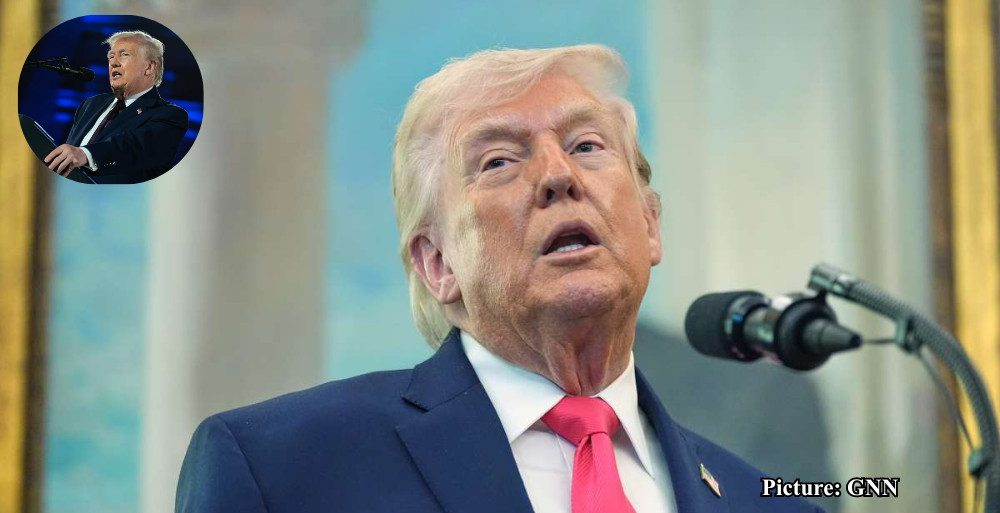
In a high-stakes televised address from the White House, President Donald Trump informed the nation that the month-long military campaign against the Islamic Republic of Iran is “nearing completion” following the successful neutralization of key leadership figures. The President’s remarks come amidst a backdrop of unprecedented regional instability, marked by over 900 joint U.S.-Israeli strikes since late February and a massive Iranian retaliatory campaign involving thousands of drones and missiles launched at Gulf allies and U.S. assets. As the humanitarian and economic toll of the conflict mounts—evidenced by soaring global oil prices and the closure of the Strait of Hormuz—the President also issued a stark ultimatum to NATO allies, threatening a total U.S. withdrawal from the alliance over their refusal to provide direct military support in the conflict.
WASHINGTON — President Donald Trump, speaking from the Oval Office on April 1, 2026, declared that the primary strategic objectives of the United States’ military intervention in Iran have been largely achieved. The address, characterized by a mix of triumphalism and sharp warnings to international allies, marks a pivotal moment in a conflict that began on February 28, 2026, under the banner of “Operation Epic Fury.”
The President asserted that the initial phase of the war, which targeted Iran’s nuclear facilities, ballistic missile sites, and command-and-control infrastructure, has fundamentally altered the geopolitical landscape. “Iran has been essentially decimated,” Trump stated, maintaining a composed yet firm posture. “The hard part is done, so it should be easy. We are going to hit them extremely hard over the next two weeks to finish the job.”
The Fall of the Supreme Leader and Succession Crisis
At the heart of the President’s briefing was the confirmation of the death of Iran’s Supreme Leader, Ayatollah Ali Khamenei. Khamenei was reportedly killed during the opening 12 hours of the campaign when U.S. and Israeli forces launched nearly 900 precision strikes. Intelligence officials noted that the timing of the operation was specifically calibrated to catch the 86-year-old leader before he could retreat to a secure bunker.
In the power vacuum following the strike, Tehran’s Assembly of Experts quickly moved to appoint Mojtaba Khamenei, the late leader’s 56-year-old son, as his successor. The transition has been met with skepticism by the White House. President Trump dismissed the appointment during his address, labeling the younger Khamenei an “unacceptable choice” and suggesting that the United States would have a significant say in the future governance of the nation.
While the new leadership in Tehran has called for national unity, the country remains internally fractured. The strikes followed a period of intense domestic unrest in early 2026, where a failing economy and crumbling infrastructure led to widespread protests that the previous regime had suppressed with lethal force.
A Region Under Fire: Retaliation and Economic Paralysis
The scale of the Iranian response to the U.S.-Israeli offensive has been massive. According to defense data, Iran has launched more than 2,000 drones and hundreds of ballistic missiles across the Middle East. The United Arab Emirates alone reported intercepting 438 ballistic missiles and 2,012 drones as of April 1, using U.S.-provided THAAD and Patriot systems. Despite high interception rates, debris has caused significant damage to civilian infrastructure in Abu Dhabi and Dubai, including strikes near Dubai International Airport and the Jebel Ali Port.
The humanitarian impact extends beyond Iran’s borders. In Lebanon, Israeli strikes against Hezbollah—Iran’s primary regional proxy—have resulted in thousands of casualties and the displacement of over one-sixth of the population.
Economically, the conflict has paralyzed the Strait of Hormuz, a waterway responsible for the passage of roughly 20% of the world’s petroleum. “While some Iranian-linked vessels continue to move, almost all other commercial shipping has ceased,” noted one maritime analyst. This bottleneck has sent global oil and gas prices to record highs, prompting the U.S. to temporarily lift sanctions on certain Russian and Iranian oil already in transit to stabilize the market.
The NATO Ultimatum and Diplomatic Friction
Perhaps the most significant domestic and international fallout of the address was President Trump’s renewed threat to withdraw the United States from NATO. The friction stems from the refusal of major European powers—specifically France, Germany, and the UK—to join the active combat operations.
“I always knew the Alliance would never help the U.S.,” Trump remarked, expressing deep frustration that European nations have declined to assist in securing the Strait of Hormuz. He confirmed he is “absolutely” considering an exit from the treaty, calling the organization a “paper tiger” in its current state.
This rhetoric has sparked a firestorm on Capitol Hill. A bipartisan group of senators, including Republican Mitch McConnell and Democrat Jeanne Shaheen, issued a joint statement reminding the administration that NATO is the only entity to have ever invoked Article 5 in defense of the United States. “Any president contemplating withdrawal is fulfilling the greatest dreams of Vladimir Putin,” the statement read.
NATO Secretary General Mark Rutte is scheduled to arrive in Washington next week for emergency talks. Rutte has previously pushed for all members to increase defense spending to 5% of GDP by 2035, but the current conflict has exposed deep ideological rifts regarding “regime change from the skies”—a strategy UK Prime Minister Sir Keir Starmer has publicly criticized.
Historical Roots and Future Uncertainty
The current hostilities are the culmination of decades of adversarial relations, beginning with the 1953 coup and the 1979 Islamic Revolution. However, the 2026 war represents the most direct and destructive confrontation in the history of the two nations. Analysts suggest that the U.S. and Israel calculated that Iran’s weakened state—following years of sanctions and the 12-day “June War” in 2025—presented a window of opportunity to dismantle its nuclear program permanently.
While President Trump suggests the “hard part is done,” the path to a diplomatic resolution remains obscured. Reports indicate that while the U.S. has proposed a lifting of sanctions in exchange for a total end to nuclear enrichment, Iran has countered with demands for reparations and sole control over the Strait of Hormuz. As the April 6 deadline for reopening the waterway approaches, the international community remains on high alert for a potential escalation into a broader global conflict.
Tags: President Trump, Iran War 2026, NATO Withdrawal, Strait of Hormuz, Mojtaba Khamenei, US-Israel Military Strike, Global Oil Crisis, Operation Epic Fury, Middle East Conflict, Mark Rutte