
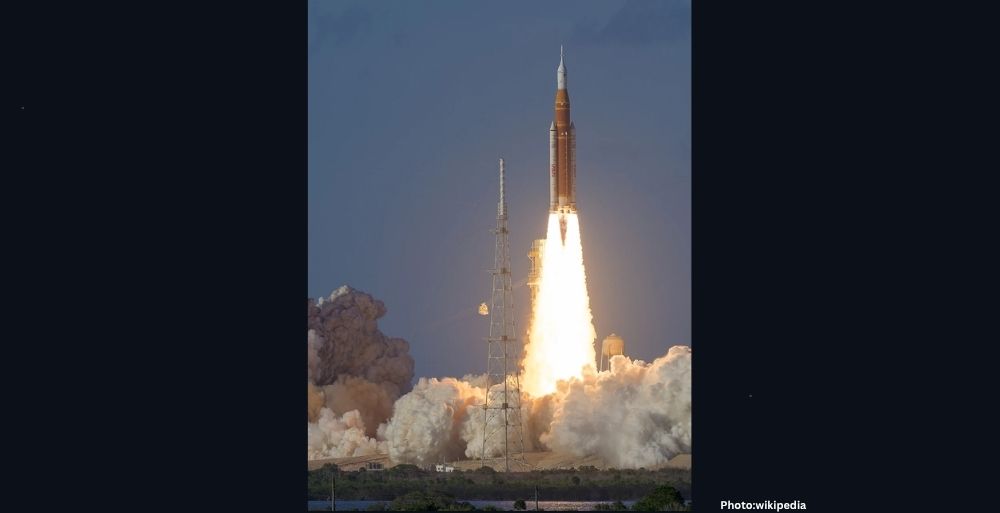
NASA’s Artemis II mission has released awe-inspiring images of Earth, marking a pivotal moment in lunar exploration as astronauts venture around the Moon for the first time since 1972.
On April 3, 2026, NASA’s Artemis II mission reached a significant milestone as astronauts aboard the Orion spacecraft captured breathtaking images of Earth from a distance of approximately 97,843 miles. This mission represents the first crewed flight to orbit the Moon since the Apollo missions concluded in 1972, rekindling public interest in lunar exploration.
The images shared by NASA depict a partial view of Earth, visible through a window of the Orion capsule, showcasing a vibrant planet shrouded in swirling clouds. A second image provides a complete view of Earth, highlighting the magnificent auroras that illuminate parts of its atmosphere. Reid Wiseman, the mission’s commander, was responsible for capturing these remarkable photographs.
Reflections on Unity and Humanity
In a video call with ABC News, Victor Glover, the pilot of Artemis II and the first Black astronaut to travel to deep space, expressed his emotional response to viewing Earth from such a distance. “You look amazing, you look beautiful,” Glover said, emphasizing the unifying effect of observing our planet from space. He remarked, “No matter where you are from or what you look like, we’re all one people,” underscoring the sense of global unity that space travel promotes.
Diverse Crew and Mission Overview
The Artemis II crew comprises four astronauts: Christina Koch, the first woman to journey around the Moon; Victor Glover; Reid Wiseman; and Jeremy Hansen, the first Canadian astronaut to partake in this lunar mission. This diverse crew reflects NASA’s commitment to inclusivity and represents significant milestones in the representation of women and minorities in the field of space exploration.
On Thursday, following successful tests of various systems aboard the Orion spacecraft while in Earth orbit, NASA executed the capsule’s final major engine burn, officially committing the crew to their lunar journey. Christina Koch remarked just before the maneuver, “With this burn to the moon, we do not leave Earth; we choose it,” highlighting the intentionality and purpose behind their mission.
Mission Activities and Preparations
As of the third day of their 10-day mission, the crew was scheduled to wake up in the early afternoon (Earth time) and engage in an array of activities, including an in-space CPR demonstration and testing emergency communication systems. These rigorous training exercises are crucial to ensure the crew’s preparedness for potential challenges during their journey.
On Day 6 of the mission, the Artemis II crew is anticipated to loop around the far side of the Moon, marking the first human visit to this region in over half a century. This historic flyby will allow the astronauts to conduct scientific observations that could inform future lunar explorations. As the mission progresses, the crew plans to rehearse these observations in anticipation of their approach to the Moon.
Returning to Earth: The Splashdown
Following their lunar reconnaissance, the astronauts will utilize the Moon’s gravitational pull to facilitate their return to Earth, culminating in a planned splashdown in the Pacific Ocean on the final day of their mission. This return will serve as a significant closure to a journey that not only advances scientific understanding but also reignites public interest in space exploration and the potential for future lunar habitation.
The Broader Implications of Artemis II
The Artemis program, initiated by NASA, aims to return humans to the Moon and establish a sustainable presence by the end of the decade, ultimately preparing for future missions to Mars. The successful execution of Artemis II is a crucial step toward these ambitious goals and represents a renewed commitment to human space exploration.
Artemis II is also significant in the context of international collaboration in space exploration. The involvement of Canadian astronaut Jeremy Hansen exemplifies the cooperative efforts between nations in advancing scientific discovery beyond Earth. Such collaborations not only enhance the capabilities of space agencies but also foster a shared commitment to exploring the cosmos.
As this mission progresses, the Artemis II crew’s experiences and findings could provide invaluable insights into the challenges of long-duration spaceflight and the complexities of human adaptation to extraterrestrial environments. The data collected during this mission will be instrumental in informing future missions and ensuring the safety and success of those who venture into space.
With the successful launch and operation of Artemis II, NASA aims to inspire a new generation of scientists, engineers, and explorers. The mission serves as a reminder of humanity’s inherent curiosity and desire to explore the unknown, reinforcing the notion that space exploration is a collective endeavor that transcends national boundaries.