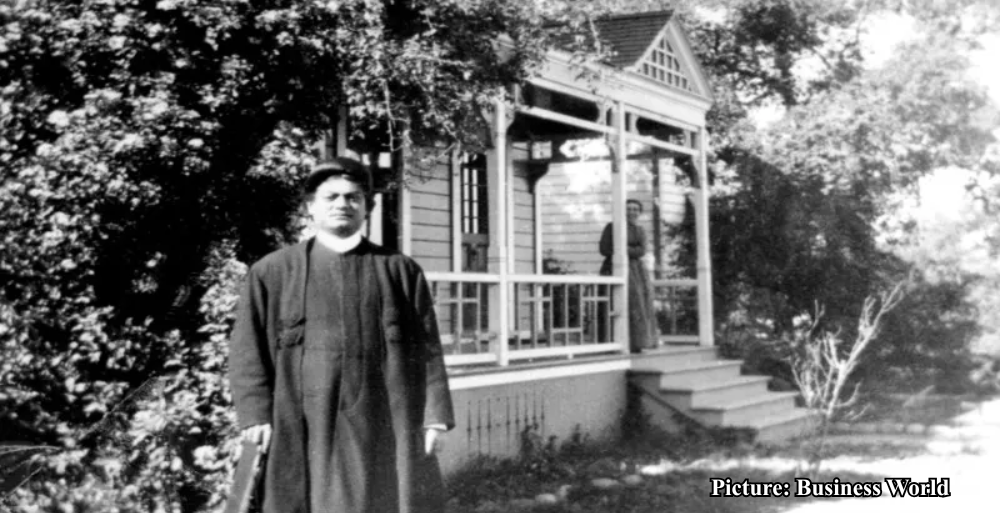
Monday, September 11, 1893. Chicago was warm for that late point in the summer. The city had arranged for itself an event of considerable self-congratulation: the Parliament of the World’s Religions, attached to the World’s Columbian Exposition, which was itself a celebration of four centuries since Columbus’s arrival in the Americas. Hundreds of thousands of visitors thronged the Permanent Memorial Art Palace. They had come from the great nations, from the established faiths, from the civilisations that considered themselves, with some confidence, the centre of things.
Into this assembly on its opening day walked a strikingly good-looking Indian monk. He was barely thirty years old. He wore ochre robes. He carried nothing of material consequence except his learning. This requires a moment’s pause. India in 1893 was a possession. It was a colony of the British Empire. Swami Vivekananda, born Narendranath Datta (1863-1902), to an aristocratic family, rose before seven thousand delegates at the extraordinary interfaith conference, a symbolic world stage, as the thirty-first speaker. He had never addressed such an international assembly.
He addressed that gathering as “Sisters and brothers of America.” The hall, filled with over 7,000 attendees, erupted in applause. It took a full two minutes for the appreciation to subside. In that single salutation, the Indian monk did something quietly revolutionary: he reminded a fractured world that humanity shares one family, one home.
That day, Swami Vivekananda, a person of genuine spiritual intensity and remarkable intellectual gifts, delivered an enlightened talk on universal tolerance and acceptance. Speaking without notes, he said that all religions are simply different paths leading to the same divine truth.
He added, “I am proud to belong to a nation which has sheltered the persecuted and the refugees of all religions and all nations of the earth. I am proud to tell you that we have gathered in our bosom the purest remnant of the Israelites, who came to southern India and took refuge with us in the very year in which their holy temple was shattered to pieces by Roman tyranny. I am proud to belong to the religion which has sheltered and is still fostering the remnant of the grand Zoroastrian nation.” He unflinchingly told the Parliament that fanaticism had “filled the earth with violence, drenched it often and often with human blood, destroyed civilisation, and sent whole nations to despair.”
In conclusion, he pleaded for the end of sectarianism, bigotry, and fanaticism. The deafening applause that had interspersed his talk thundered at its close. Swami Vivekananda’s speech in Chicago lasted only a few minutes. It was, by any measure, an extraordinary moment. By quietly redefining human solidarity, Swami Vivekananda became the star at the Parliament.
Following his triumphant appearance at the 1893 Parliament of Religions in Chicago, Swami Vivekananda leaped from obscurity to fame. The New York Herald wrote: “Swami Vivekananda is undoubtedly the greatest figure in the Parliament of Religions.” The electric effect of his speech remains a landmark in the history of global religious thought. He had expressed the modern world’s craving to tear down the barriers of caste, colour, and creed and to merge all people into one humanity. It marked a shift toward acknowledging the diversity of spiritual paths and set the stage for interfaith collaboration in the modern era.
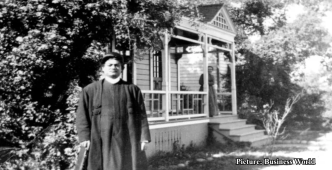
Most notably, he also established a bridge between the East and the West. His ideas found a receptive audience among educated Americans interested in ancient Indian spirituality. Recognised as the messenger of ancient Indian wisdom to the world, Swami Vivekananda continued to attract attention, delivering lectures across America and immersing himself in American culture. He returned to America for a second visit in 1899. He stayed in a Victorian house at 309 Monterey Road in South Pasadena, where he attracted local intellectuals and spiritual seekers. The house, now called Vivekananda House, is a Los Angeles landmark. Swami Vivekananda passed away on July 4, 1902, less than nine years after his appearance at the World’s Parliament of Religions. He was only 39.
More than a hundred and thirty years have passed since Swami Vivekananda’s address that morning. We have since seen two full-scale world wars, a Cold War that kept two nuclear arsenals in a state of permanent readiness, several genocides, sectarian conflicts, ethnic cleansing, ideological terrorism, a pandemic, and assorted catastrophes too numerous to list.
Fanaticism has continued its work. Today, humanity possesses technologies Swami Vivekananda could not have imagined: artificial intelligence, WMDs, and social media algorithms that can radicalise a mind in days. And yet the fracture lines he isolated, the weaponisation of identity, the hardening of one partial truth into an absolute, remain almost identical. Echo chambers harden the conviction that the other side is not merely wrong but an evil threat, an abstraction suitable for hatred or perhaps elimination. Looking at the 21st century, his words about fanaticism read less like history and more like the morning news.
The words Swami Vivekananda offered in 1893 retain an urgency today. A man of profound faith, he sought a philosophical diagnosis of humanity’s deepest wound and a prescription drawn from the ancient wells of Indian thought. His argument was that smallness is the problem, the smallness of a mind that mistakes its portion of truth for the whole of it. He drew a distinction the modern world still struggles to grasp: the deeper meaning of acceptance. It means recognising that the river running through your village and the river running through another’s are both water, both sacred, both bound for the same sea. Real peace cannot be negotiated only at the level of borders and treaties.
It must be negotiated first at the spiritual level. His message is not a political platform. It is a spiritual orientation, a call to what he elsewhere described as seeing the Divine in every face, every creature, every nation. When we cease to see the humanity in those who differ from us, we have already begun the war that later arrives with deadly weapons. Swami Vivekananda did not offer world peace as an achievable political project in a single century; he was too wise for that. He offered it as a direction of travel, a north star: each person doing the inner work of expanding their circle of belonging, each community choosing coexistence over exclusion.
What the world needs in 2026 is exactly what it needed in 1893: not the silencing of difference, but the courage to meet across it. Not the erasure of identity, but the recognition that identity need not become a weapon. Swami Vivekananda walked into that Chicago hall as a stranger from a colonised land, addressing seven thousand strangers as his family, and was met as a brother. He walked out having demonstrated that such a meeting is possible. That demonstration, repeated in enough places, by enough people, across enough borders, is what world peace is made of.
Swami Vivekananda’s voice still carries. We need only choose to listen.